Yoga for Back Pain: 10 Poses That Actually Work (2026 Guide)
The right poses, the right form, and the right sequence — so yoga becomes a solution for your back, not another source of pain.
admin
500-hr Yoga Alliance · Therapeutic Yoga
June 16, 2026
10 min read
You shift in your chair. Stretch your neck. Roll your shoulders. Feel that familiar ache settle into your lower back — and tell yourself you’ll deal with it later. Later never comes.
Back pain is India’s most ignored epidemic. According to the Indian Journal of Orthopaedics, over 60% of working Indians experience significant back pain before the age of 45. Desk jobs, long commutes, poor posture, and a decade of working from sofas and dining chairs have made chronic back pain the default condition of modern Indian life.
The good news? Yoga is one of the most clinically validated treatments for back pain in existence — not as a vague wellness practice, but as a specific, pose-by-pose therapeutic yoga for back pain intervention.
The catch? Done incorrectly, it can make things worse. This guide gives you the right poses, the right form, and the right sequence — so yoga becomes a solution, not another source of pain. Looking at your options? See our guide to online yoga apps for beginners in India.
Why your back hurts — and why yoga addresses the root cause
Most back pain isn’t caused by a single injury. It’s the result of accumulated imbalances — muscles that are chronically tight pulling against muscles that are chronically weak, compressing the spine and stressing the joints over months and years. The three most common culprits:
🌿
Tight hip flexors
Hours of sitting shorten the muscles connecting pelvis to thighs. They pull the pelvis forward, deepen the lower-back curve, and compress the lumbar spine.
🛡️
Weak core muscles
The deep stabilising muscles around your trunk are the spine’s natural support. When they weaken from inactivity, the spine bears load it was never meant to carry alone.
🦴
Poor postural habits
Rounded shoulders, forward head, and a collapsed chest shift your centre of gravity — creating uneven, constant load on the spine. See: yoga for posture correction.
Why yoga works: unlike pain medication or passive rest, yoga addresses all three at once. It lengthens tight muscles, strengthens weak ones, and retrains your nervous system to hold better posture — not just during practice, but throughout your day.
⚠️
Important: read before you begin
If your back pain comes with any of the following, consult a doctor before starting yoga:
Pain radiating down one or both legs (sciatica)
Numbness or tingling in the legs or feet
Pain following a fall or accident
Bladder or bowel changes alongside back pain
Fever with back pain
For general chronic back pain, muscle tension, stiffness, and desk-related discomfort, yoga is safe to begin immediately. Start gently and never push into sharp or shooting pain.
10 yoga poses for back pain relief
Each pose targets a specific link in the chain — decompressing, mobilising, or strengthening. Read the correct form and common mistake notes carefully; with back pain, technique is everything.
Replace: 800×1000px · Expectation pose image (confident form) EXPECTATION What you feel like you’re doing.
Replace: 800×1000px · Reality pose image (real form without feedback) REALITY What the camera actually captures — knee caved, hips off-square, shoulders uneven.
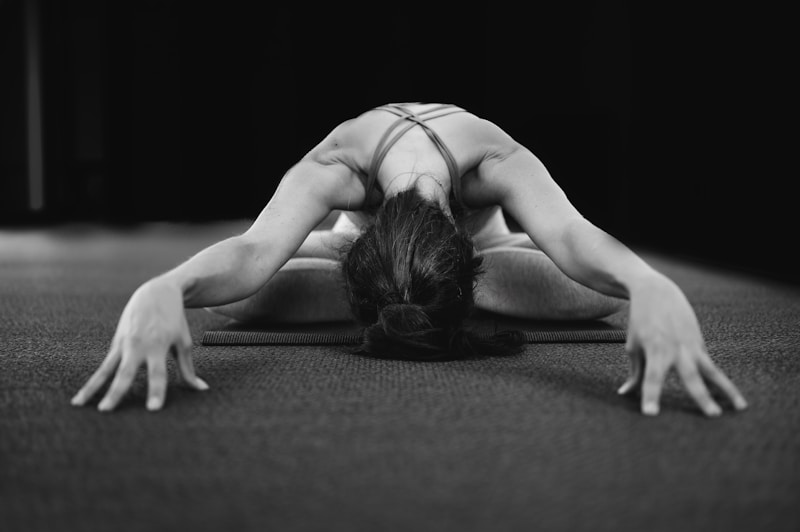
Kneel and sit back toward your heels. Fold forward, extend your arms in front of you, forehead resting on the mat. Let your chest sink toward the floor with each exhale.
Why it works
Child’s Pose gently decompresses the lumbar spine — the opposite of what sitting does all day. It creates traction in the lower spine, giving compressed discs space to breathe.
Correct form
Keep big toes touching and knees wide. If your hips don’t reach your heels, place a folded blanket between thighs and calves.
Common mistake
Holding tension in the shoulders. Let your arms be heavy, elbows soft. AI tip: Yogain tracks whether your spine lengthens evenly or collapses to one side — a common asymmetry in one-sided back pain.
On hands and knees, wrists under shoulders, knees under hips. Inhale: drop the belly, lift chest and tailbone (Cow). Exhale: round the spine to the ceiling, tuck chin and tailbone (Cat). Flow slowly.
Why it works
The single most effective warm-up for a stiff back. It mobilises every segment of the spine and syncs movement with breath, activating the parasympathetic nervous system to reduce pain perception.
Correct form
Move slowly and continuously — the movement should feel like a wave travelling up the spine, not a jerk in the lower back.
Common mistake
Only moving in the lumbar region. Consciously include the mid-back (thoracic) and neck (cervical) spine.
3
Replace: 600×480px · Downward Facing Dog / Adho Mukha Svanasana
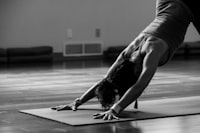
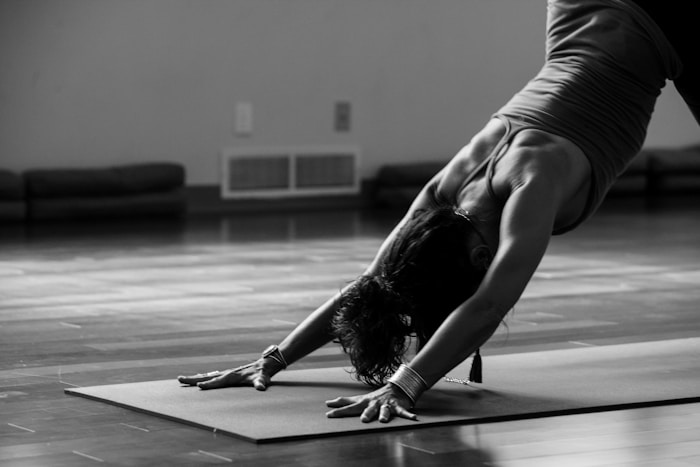
From hands and knees, tuck your toes and lift your hips high and back into an inverted V. Press through your palms, spread your fingers, lengthen your spine. Heels need not touch the floor.
Why it works
Simultaneously stretches the hamstrings (a primary driver of lower back pain), decompresses the lumbar spine, and builds shoulder and upper-back strength. The most complete single pose for back health.
Correct form
Priority is a long, straight spine — not straight legs. Bend the knees generously to keep your back flat.
Common mistake
Dumping weight into the wrists. Press through all ten knuckles. AI tip: Yogain’s 14-point tracking detects hip rotation — asymmetry here is a key cause of one-sided back pain.
Stand feet hip-width apart. On an exhale, hinge at the hips and fold forward, letting the upper body hang heavy. Hold opposite elbows and sway gently. Let your head hang completely.
Why it works
Gravity does the work. With the spine released from its load-bearing role, the vertebrae decompress and the muscles along the entire back get a deep, passive stretch.
Correct form
Keep a generous bend in the knees — this is not a flexibility test. The goal is spinal release, not touching the floor.
Common mistake
Rounding only the lower back while the upper back stays stiff. Release the entire spine, starting from the neck.
Lie on your back, knees bent, feet flat and hip-width. Press into your feet and lift your hips. Squeeze the glutes, engage the core, hold. Lower slowly on an exhale.
Why it works
Directly strengthens the glutes and lower-back muscles — the primary support for the lumbar spine. Weak glutes are one of the most under-recognised causes of chronic lower back pain.
Correct form
Feet parallel, knees tracking over the second toe. The body forms a straight diagonal line from shoulders to knees at the top.
Common mistake
Knees splaying outward or heels lifting. AI tip: Yogain detects knee alignment in Bridge Pose in real time — knee collapse is the most common error and directly stresses the lower back.
SUPTA MATSYENDRASANA · Best for: Thoracic rotation, sacral tension · Hold: 8–10 breaths / side
How to do it
Lie on your back. Hug the right knee to your chest, then guide it across your body to the left. Extend the right arm out and look right. Let gravity do the twisting. Repeat other side.
Why it works
Twists decompress the facet joints of the spine, release the muscles along the sides of the back, and restore rotational mobility lost to seated posture. The supine version needs no effort — ideal for inflamed or acute pain.
Correct form
Keep both shoulders on the floor. If the twisted knee lifts a shoulder, reduce the range of the twist.
Common mistake
Forcing the knee all the way to the floor. The twist comes from releasing, not pushing.
7
Replace: 600×480px · Legs Up the Wall / Viparita Karani
Sit sideways close to a wall, then swing your legs up as you lower your back to the floor. Rest with legs vertical against the wall, arms open at your sides. Close your eyes and breathe naturally.
Why it works
This gentle inversion fully unloads the spine. It drains fluid pooled in the legs, reduces inflammation, and activates the parasympathetic system. Often the single most relieving pose for acute flare-ups.
Correct form
A small gap between your sit bones and the wall is fine. A folded blanket under the hips adds lower-back support.
Common mistake
Trying to get the sit bones flush against the wall. If it creates tension, move further away.
Lie face down, arms alongside your body, palms down. On an inhale, lift chest, arms, and legs off the floor together. Hold, squeezing the glutes and engaging the back. Lower slowly.
Why it works
One of the most effective back-strengthening poses in yoga. It builds the erector spinae — the long muscles either side of the spine — essential for upright posture and preventing the collapse that causes chronic pain.
Correct form
Keep your gaze down toward the floor to protect the neck. Reach actively through the toes.
Common mistake
Holding the breath. Breathe steadily throughout — the pose becomes far more effective with continuous breath.
MARJARYASANA VARIATION · Best for: Upper back, thoracic rotation, shoulders · Hold: 8 breaths / side
How to do it
On hands and knees, slide your right arm under your left, palm up, lowering your right shoulder and temple toward the floor. Keep the left arm extended. Hold, breathe, return to centre, switch sides.
Why it works
Upper back pain — especially between the shoulder blades — comes from tight thoracic rotators and rhomboids. Thread-the-Needle is the most targeted release for the muscles behind the hunched, rounded-shoulder posture of desk work.
Correct form
Keep the hips level and directly over the knees. The twist should come from the thoracic spine, not the lumbar.
Common mistake
Letting the hips shift or collapse to one side as you thread the arm under.
Lie flat on your back, arms slightly away from the body, palms up, feet falling open. Close your eyes. Do nothing. Breathe naturally. Stay completely still.
Why it works
Savasana is not a rest — it is when the therapeutic work integrates into the nervous system. The anti-inflammatory effects of yoga on the back are significantly reduced without it.
Correct form
If your lower back arches uncomfortably, place a rolled blanket or bolster under your knees.
Common mistake
Leaving early. Set a timer and commit to the full duration — this is not optional.
Put it all together: the right sequence
Don’t pick poses at random. The sequence below is designed to progressively and safely open the back — release first, warm up, lengthen, strengthen, then restore.
35–40 MIN · 4–5× PER WEEK
Follow this order, every session.
Each pose prepares the body for the next. Skipping the warm-up or going straight to strengthening causes exactly the kind of strain yoga is meant to prevent.
Total time: 35–40 minutes. Frequency: 4–5 times per week for best results. When: morning for stiffness relief, evening for tension release — both work.
Lower back vs upper back pain: which poses to prioritise
Lower and upper back pain have different drivers and respond to different poses. Knowing which you’re dealing with lets you spend your practice where it counts most.
Factor
Lower Back Pain
Upper Back Pain
Primary cause
Tight hip flexors, weak glutes, lumbar compression
Rounded shoulders, tight chest, weak rhomboids
Best poses
Child’s Pose, Bridge, Forward Fold, Locust
Thread-the-Needle, Cat–Cow, Downward Dog
What to avoid
Deep backbends without warm-up
Excessive forward folding without chest opening
Common trigger
Prolonged sitting, driving
Screen time, desk posture
Yogain AI focus
Tracks hip–lumbar angle
Tracks shoulder rounding & thoracic curve
Yoga for cervical pain (neck & upper back)
Cervical pain — pain in the neck and upper spine — is increasingly common in India due to phone and laptop use. See also: yoga for cervical pain. Specific poses that help:
Neck rolls in Tadasana — slow, full-range neck circles before any session
Gomukhasana arms — opens the chest and releases neck tension
Supported Fish Pose — counteracts forward head posture from screen time
Important: for diagnosed cervical spondylosis or herniated cervical discs, practise only under the guidance of a certified instructor. Yogain’s live classes provide real-time instruction appropriate for cervical conditions.
Why correct form matters more than most people think
For most yoga, incorrect form simply reduces the benefit. For back-pain yoga, incorrect form can actively make the condition worse. Three specific risks:
1. Forward folds with a rounded lower back
Folding with a rounded lumbar spine instead of hinging from the hips puts direct compressive force on the lumbar discs — the opposite of the intended effect.
2. Bridge Pose with knees splaying
Knee collapse in Bridge reduces glute activation and transfers the work to the lower-back muscles — worsening the very problem the pose is meant to address.
3. Downward Dog with a rounded upper back
A collapsed thoracic spine puts the lower back into compensatory hyperextension — increasing, not decreasing, lumbar compression.
This is precisely why AI posture correction is especially valuable for back-pain yoga. Yogain’s real-time tracking catches these errors in the moment — not after three weeks of reinforcing a wrong pattern.
AI POSTURE MONITORING · IN-APP VIEW
14 landmarks. 30 frames a second. On-device.
The green nodes are your joints. The lines between them are angles the model checks against ideal pose geometry. When a knee drops or your spine rounds, the dot turns amber — and the cue lands instantly, not five poses later.
Yogain users report a 3× improvement in form accuracy within 4 weeks of consistent practice — because every session gives objective feedback, not vague encouragement.
89%
AVG ACCURACY WK 4
+14%
VS WEEK ONE
DAILY ACCURACY%
M
T
W
T
F
S
S
Warrior II
94%
Downward Dog
88%
Bridge Pose
71%
How often should you practise?
Consistency matters far more than duration. Twenty minutes four times a week outperforms ninety minutes once a week, every time.
Frequency
Expected result
1× per week
Mild temporary relief — pain returns between sessions
3× per week
Noticeable reduction in pain within 3–4 weeks
4–5× per week
Significant structural improvement within 6–8 weeks
Daily (20–30 min) RECOMMENDED
Fastest results — most Yogain users report 60–70% pain reduction within 4 weeks
What to avoid when doing yoga for back pain
A few habits quietly work against your spine. Steer clear of these while your back is healing:
🚫 Avoid
Why
Deep backbends (Wheel, Cobra) without warm-up
Compress the lumbar vertebrae when the spine is cold and unprepared
Sharp pain signals nerve or disc involvement — stop immediately and rest
Skipping Savasana
It is the integration phase — the therapeutic effect is incomplete without it
Practising only when pain is severe
Preventive practice 4–5×/week beats reactive practice every time
Start healing your back today
The ten poses in this guide are clinically validated and instructor-designed. But knowing the poses is only half the equation — doing them correctly is what creates the results.
Yogain’s best online yoga classes include sequences specifically designed for back pain, led by Manisha, a 500-hour certified instructor specialising in therapeutic yoga. The AI posture correction ensures your form is right from day one, so you’re healing — not reinforcing harmful patterns.
First results: most practitioners notice reduced stiffness within 7–10 days. Structural improvement: significant pain reduction within 4–6 weeks of consistent practice. Start with a free 10-day trial — no commitment required.
Frequently asked
Quick answers, before you commit.
Yes — yoga is one of the most evidence-backed treatments for chronic back pain. Multiple clinical studies, including a 2017 Annals of Internal Medicine study, found yoga as effective as physical therapy for chronic lower back pain.
Child’s Pose, Bridge Pose, and Supine Spinal Twist are the three most effective poses for immediate lower back relief. For long-term strengthening, Locust Pose and Downward Dog are essential.
Yes — if practised with incorrect form. This is why alignment and posture correction are critical, especially for poses like Forward Fold and Bridge. AI-guided platforms like Yogain reduce this risk with real-time form feedback during every session.
Most people notice reduced stiffness within 7–10 days of consistent practice (4–5× per week). Significant pain reduction typically occurs within 4–6 weeks.
Gentle yoga can be beneficial for herniated discs, but specific poses must be avoided. Consult your doctor first, and practise only with a certified instructor who understands your condition.
Yes — a gentle 20–30 minute sequence daily is ideal for chronic back pain. Avoid high-intensity sessions on consecutive days and always include Savasana for full integration.
Lower back pain responds best to hip-opening and spinal decompression poses. Upper back pain responds best to thoracic rotation and chest-opening poses. Both benefit from Cat–Cow and Downward Dog practised daily.
Beginners should start with Child’s Pose, Cat–Cow, and Legs Up the Wall — all are safe, require no flexibility, and provide immediate relief. See our guide to online yoga apps for beginners in India for structured beginner programmes with AI guidance.
WRITTEN BY
admin
Lead instructor at Yogain Wellness. 500+ hour Yoga Alliance certified with a Master's degree in Yoga Studies and 7+ years of teaching experience.
Start your AI yoga journey today
Stop guessing, start measuring.
Yogain offers a free 10-day trial — no commitment, no credit card stress. Experience live classes with real-time AI posture correction and see your accuracy scores for yourself.